
In this article
BigCommerce Overview & 2026 Industry Position
BigCommerce is a leading open SaaS e-commerce platform empowering merchants to build, operate, and scale their online businesses with flexibility and control. Unlike closed platforms like Shopify, BigCommerce offers a decoupled architecture that supports greater customization and enterprise-grade features, without requiring merchants to self-host or code from scratch.
In 2026, BigCommerce continues to be a dominant force among mid-market and enterprise digital retailers, supporting global brands in fashion, B2B, electronics, sports, and wholesale trade. Its continued investment in headless commerce, multi-storefronts, and cross-border tools has secured its relevance amidst the growing complexity of global eCommerce compliance, taxation, and AI-assisted personalization.
From Launch to 2026: BigCommerce’s Journey
Launched in 2009 by Eddie Machaalani and Mitchell Harper, BigCommerce started as a simple platform for SMBs to launch online stores. Key product evolutions and milestones include:
- 2016: Introduced multi-channel selling with native integrations for Amazon, eBay, and Facebook.
- 2018: Rolled out enterprise features aimed at migrating larger brands from Magento and custom shops.
- 2020: IPO signaled broader ambitions and commercial stability.
- 2021: Launched B2B Edition, targeting wholesale workflows.
- 2023: Introduced multi-storefront architecture with unified back end.
- 2024: Released AI-powered product recommendation engine.
In 2026, BigCommerce’s strategy centers around scalable internationalization, native AI tools in inventory and merchandising, and expanding Headless-as-a-Service capabilities for growing digital-first brands.
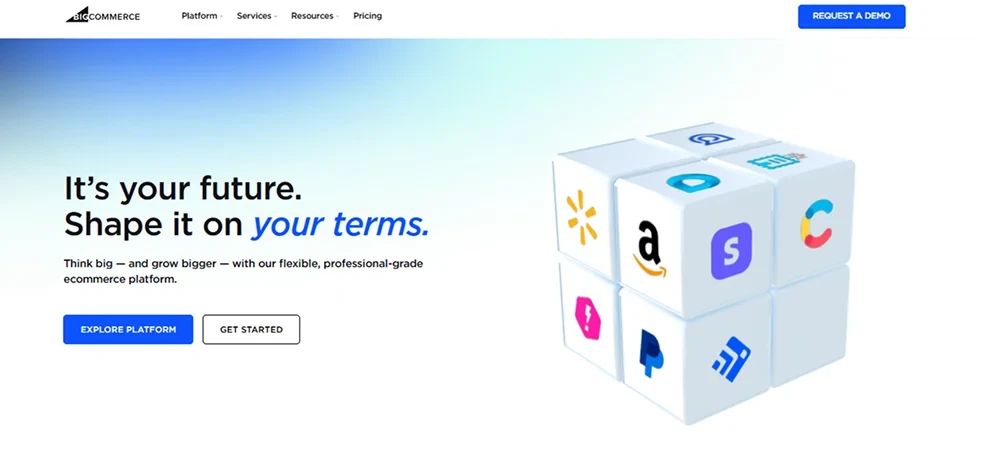
BigCommerce Key Features
- Open SaaS Flexibility: Offers both drag-and-drop builder and API extensibility for developers.
- Multi-Storefront: Manage multiple brands/sites from a single dashboard.
- Headless Commerce: Supports front-end freedom via Next.js, Vue, and more.
- B2B Suite: Includes company profiles, price lists, quote workflows, shared carts, and purchase orders.
- AI Merchandising Tools: Product recommendations, predictive search, and automated collections.
- Native Internationalization: Currency, tax, and fulfillment logic adaptable to >150 countries.
- Multi-Channel Sync: Native connections to Instagram, TikTok, Pinterest, Amazon, Walmart.
Workflow & UX
BigCommerce blends enterprise-grade flexibility with a clean merchant interface. The Control Panel unifies marketing, catalog, content, orders, and analytics while allowing developers access via GraphQL and REST APIs. The new Store Design App streamlines front-end editing — particularly useful for marketing teams managing seasonal landing pages.
Custom workflows using webhooks and third-party ERP or shipping platforms are easier than ever with built-in connectors. For B2B sellers, the UX now supports customer-specific pricing and account hierarchies with modest training required.
BigCommerce Pricing Analysis & Value Metrics
All pricing is accurate as of July 2026 and billed monthly. Annual discounts apply.
| Plan | Monthly Price | Best For | Includes |
|---|---|---|---|
| Standard | $39 | Small businesses | Up to $50k sales/year, 1 storefront, basic SEO, PayPal/Stripe |
| Plus | $105 | Growing brands | Abandoned cart, segmentation, analytics, up to 3 storefronts |
| Pro | $399 | Midsize merchants | Google reviews, custom SSL, API limits increased |
| Enterprise | Custom quote | Large-scale retailers | B2B suite, high-volume API, dedicated support |
BigCommerce outperforms many platforms in value-to-features ratio, particularly given its inclusion of multi-storefronts and inherent B2B tools above the Plus plan. No transaction fees also improve ROI over time.

Competitive Landscape
| Platform | Strength | Weakness | Best For |
|---|---|---|---|
| BigCommerce Standard | Open flexibility, no transaction fees | Learning curve on advanced tools | Mid-size multi-channel sellers |
| Shopify | Extremely easy for beginners | Locked-in app ecosystem | Quick-start solo retailers |
| Magento (Adobe Commerce) | Customizability, large codebase | Hosting/development required | Complex enterprise builds |
| WooCommerce | Free WordPress plugin | Plugin conflicts, hosting needed | Tech-savvy freelancers |
Use Cases
- Multi-brand retailers growing into enterprise territory
- Wholesale and B2B merchants needing quote flows & PO support
- International sellers requiring seamless multi-currency + tax
- Content-driven DTC brands building custom storefronts
BigCommerce Integrations
BigCommerce supports over 1,000 apps and integrations via its Marketplace. Key platforms include:
- Payments: Stripe, PayPal, Square, Adyen, Klarna
- Accounting: QuickBooks, Xero, Avalara for tax compliance
- Shipping & Ops: ShipStation, FedEx, ShipBob, Brightpearl
- CRM & Marketing: HubSpot, Klaviyo, Mailchimp, Yotpo
- Headless Front Ends: Shogun, Vue Storefront, Contentful
Pros & Cons
- Pros:
- No proprietary lock-in — open APIs and integrations
- Excellent for multi-store and B2B hybrid setups
- Scales to enterprise without price cliffs
- Cons:
- Takes longer to fully master than Shopify
- Requires front-end customization to look truly unique
Pro Tip: For headless builds, pair BigCommerce with a performant front end like Next.js or Shogun for maximum speed and design flexibility.
Final Thoughts
For merchants who’ve outgrown entry-level solutions and need a platform capable of adapting across B2C, B2B, and international workflows, BigCommerce is a top-tier contender in 2026. It’s not the fastest entry point for beginners, but for teams with growth ambitions and technical collaboration, its power, value, and flexibility are exceptional.
BigCommerce FAQ
Is BigCommerce better than Shopify for B2B?
Yes, BigCommerce includes native B2B functionality like shared carts, price lists, and quote workflows, whereas Shopify requires third-party apps or customization.
Does BigCommerce charge transaction fees?
No, BigCommerce does not charge additional transaction fees, regardless of payment gateway used.
Can I host multiple brands in one BigCommerce account?
Yes. BigCommerce’s Multi-Storefront feature lets you run multiple branded storefronts under one admin with shared catalogs and logic.
Is BigCommerce good for international eCommerce?
Yes. Built-in currency display, tax calculation, multilingual options, and global CDN support make it strong for internationalization.
Can I use BigCommerce with WordPress?
Yes. BigCommerce offers a WordPress plugin that lets you run a WordPress-powered site with BigCommerce as the commerce engine.