
In this article
OpenCart Overview & 2026 Industry Position
OpenCart CMS has long stood as a favorite among small-to-medium business owners seeking full control over their online stores without heavy licensing fees. As of 2026, OpenCart balances flexibility and cost-efficiency with robust customization features, a thriving extension marketplace, and new advancements supporting headless commerce and PWAs (Progressive Web Apps). In an eCommerce landscape prioritizing speed, personalization, and multichannel agility, OpenCart remains highly competitive—especially for global sellers and developer-led teams.
From Launch to 2026: OpenCart’s Journey
OpenCart was originally released in 2005 by Daniel Kerr. Starting as a basic PHP-based cart software, it quickly evolved with releases like v1.5 in 2011 (a UI overhaul), v2.x in 2014 (modular architecture improvements), and v3.0 in 2017 (support for the MVC-L architecture). Major milestones include:
- 2005: Original OpenCart release based on Perl (later rewritten in PHP)
- 2011: v1.5 introduces improved reporting, layout editor, and new admin UI
- 2014: v2.x launched with PIN system security and better extension support
- 2017: v3.0 features multi-store capability and Marketplace integration
- 2022: Support for headless commerce and compatibility for REST APIs
- 2025: v4.x rolls out with performance improvements, B2B modules, and AI-assisted admin features
2026 Strategy Thesis: OpenCart aims to become the most customizable self-hosted eCommerce engine with native support for enterprise integrations, AI product recommendations, and low-code customizations.
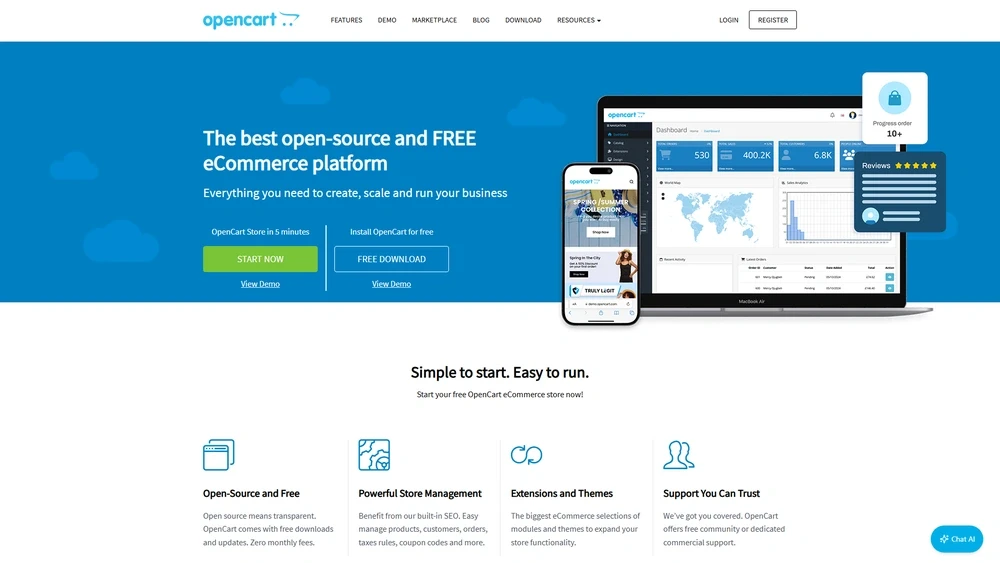
OpenCart Key Features
OpenCart platform is uniquely positioned for store owners who value modularity. Its key features include:
- Multi-store Support: Manage several online stores from a single admin dashboard
- Built-in Affiliate Module: Customize commission strategies to incentivize sales
- Extension Marketplace: 13,000+ modules including payments, SEO, marketing tools
- Multi-language and Currency: Natively supports 40+ languages
- Responsive Admin Panel: Intuitive interface with mobile-optimized dashboards
- API-First Approach: Simplified 3rd-party integrations and headless architecture
Workflow & UX
Despite its vast functionality, OpenCart offers a surprisingly clean and navigable experience. Key usability highlights include:
- Tabbed product creation with bulk upload options
- One-click module installation from the admin panel
- Custom dashboard widgets
- Multi-language inline editing
- User role permissions for different employee access levels
OpenCart Pricing Analysis & Value Metrics
| Plan | Features Included | Price (as of July 2026) |
|---|---|---|
| OpenCart Self-Hosted | Free core + paid extensions | $0 + Optional modules ($20–$200/module) |
| OpenCart Cloud Basic | Hosted, SSL, backups, support | $29/month |
| OpenCart Cloud Business | Multi-store, priority support, staging | $99/month |
| OpenCart Enterprise | Custom scaling, APIs, SLAs | From $599/month |
Value Assessment: Ideal for developers and digital agencies looking for control without recurring license fees. Most businesses can operate under $100/month.

Competitive Landscape
Here's how OpenCart stacks up against its top competitors:
| Platform | Best For | Price | Customization Level |
|---|---|---|---|
| OpenCart | Developers, Digital Agencies | Free–$99/month | High |
| Shopify | Simplified Setup | $39–$399/month | Moderate |
| WooCommerce | WordPress Users | Core Free + Paid Plugins | High |
| Magento Open Source | Enterprise w/ Dev Teams | Free + Hosting | Very High |
Common Use Cases
- Multilingual global storefronts
- SMBs needing self-hosted performance
- Custom wholesale and B2B solutions
- Digital agencies managing multi-client catalogs
- Entrepreneurs seeking full control without licensing lock-in
Integrations & Ecosystem
OpenCart offers integrations with major platforms in payments, marketing, CRM, shipping, and ERPs:
- Payments: Stripe, PayPal, Authorize.net, Square
- Marketing: Google Merchant Center, MailChimp, Facebook Pixel
- CRM: HubSpot, Zoho CRM through connectors
- Shipping: FedEx, UPS, Royal Mail, ShipStation
- Ecommerce Automation: Zapier, make.com
Pros & Cons of OpenCart
- Pros: Highly customizable, no monthly licensing fees, wide extension marketplace, global-ready, developer-friendly
- Cons: Steeper learning curve, less beginner support than hosted platforms, reliance on external developers for complex setups
Pro Tip: Use OpenCart’s “Modifications” and OCMOD system wisely—only enable the ones you truly need to avoid conflicts and boost performance.
Final Thoughts
For sellers seeking maximum control over their store structure, code access, and business logic—OpenCart remains a top-tier contender in 2026. It's not for those wanting instant plug-and-play ease, but for developers, startups, and agencies building high-performance eCommerce flows, OpenCart’s freedom and extensibility outweigh the learning curve.
OpenCart FAQ
Is OpenCart free to use?
Yes, the base version of OpenCart is free under the GNU General Public License. However, many users invest in premium extensions or themes.
Does OpenCart support mobile responsiveness?
Yes. Both the frontend and admin panel are mobile-optimized using responsive design principles starting from OpenCart 3.x onward.
Can I migrate my store to OpenCart easily?
Yes, tools like LitExtension and Cart2Cart make migration from platforms like Shopify or WooCommerce seamless.
Is OpenCart secure?
OpenCart continuously releases security patches, and users can enhance security further with extensions, SSL, and proper server configuration.
Is OpenCart suitable for B2B commerce?
Yes. Advanced pricing rules, customer groups, and quote request modules make it viable for B2B ecommerce workflows.