
In this article
HubSpot CRM Overview & 2026 Industry Position
HubSpot CRM is a powerful, user-friendly platform designed to help businesses streamline their sales, marketing, and customer service processes. Originally built to support inbound marketing efforts, it has grown into a full-fledged CRM solution used by over 180,000 customers globally. In 2026, HubSpot CRM stands out for its balance of freemium access and scalable capabilities, making it a top choice for SMBs and expanding startups navigating complex customer journeys in an AI-driven economy.
From Launch to 2026: HubSpot CRM’s Journey
Launched in 2014 as a companion to HubSpot’s marketing suite, HubSpot CRM quickly distinguished itself with a clean interface and accessible pricing model. Key milestones include:
- 2014: Launch of free CRM aimed at smaller businesses
- 2016: Introduced Sales Pro features, expanding sales pipeline functionality
- 2018: Launched Service Hub, transforming CRM into a full CX platform
- 2020: Rebuilt automation tools and introduced Operations Hub
- 2023: Deep AI and ChatGPT features integrated across hubs
- 2025: Enhanced Smart CRM capabilities and AI assistant for SMEs roll out
2026 Strategy: HubSpot CRM is doubling down on intelligent automation, embedded AI, and full-stack integrations to empower hyper-efficient growth for small and mid-market teams.
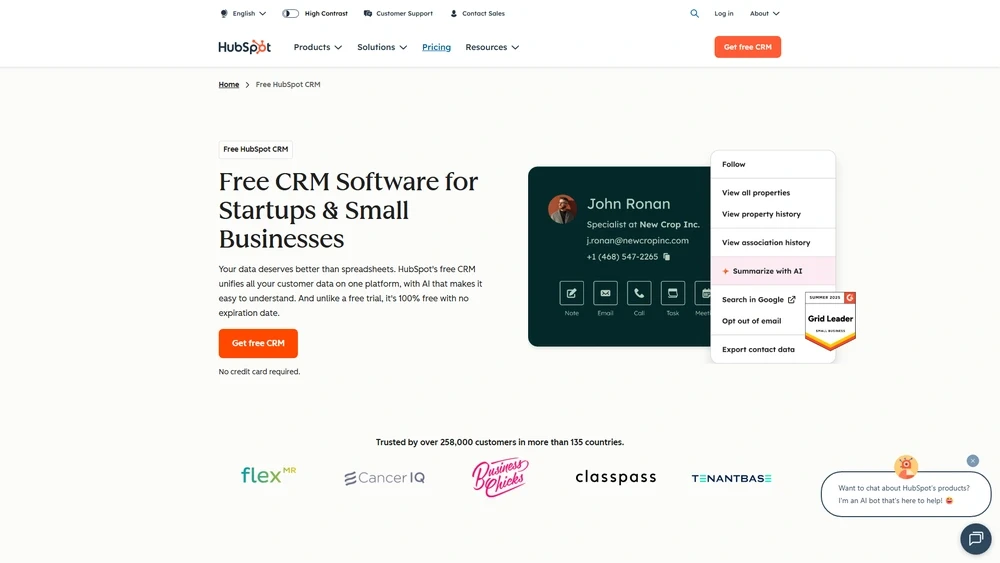
HubSpot CRM Key Features
HubSpot CRM bundles a suite of capabilities that align sales, marketing, service, and operations into a unified interface. These are some of its most compelling features in 2026:
- Smart Leads CRM: AI-assisted contact enrichment, auto-segmentation, and scoring
- Custom Pipelines: Visual drag-and-drop sales boards with automations
- Marketing Hub: Email, landing pages, and workflows all centralized
- AI Tools: Content generation, chatbot scripting, and sales forecasting now powered by GPT integrations
- Service Hub: Knowledge base, help desk, and NPS tracking
- Revenue Reporting: Custom dashboards and attribution reports
Workflow & UX
One of HubSpot CRM’s hallmark strengths remains its superior user experience. Designed with minimalism in mind, the user interface is responsive, customizable by role, and efficient for both novices and power users.
- Navigation: Global search, role-based menus, and quick-action panels
- Automation Triggers: Visual workflow builders with AI suggestions
- Mobile CRM: Native iOS/Android app support with offline mode in 2026
- UI Updates: Updated dark mode and accessibility enhancements
HubSpot CRM Pricing Analysis & Value Metrics
HubSpot CRM maintains a generous free tier, with clear upgrade paths via Hubs. As of July 2026, here's a summary of its pricing:
| Plan | Price (monthly, billed annually) | Key Features |
|---|---|---|
| Free | $0 | Up to 1M contacts, basic pipeline, email marketing, live chat |
| Starter | $20/user | Remove branding, simple automation, support channels |
| Professional | $90/user | Advanced automation, forecasting, AI predictions, custom reports |
| Enterprise | $150/user | Team hierarchies, sandboxes, advanced security, smart content |
Value Assessment: HubSpot CRM offers unmatched freemium access and tiered capabilities, ideal for scaling with your business.

Competitive Landscape
HubSpot CRM competes with several platforms in the SMB and Mid-Market space. Here’s a quick look at the alternatives:
| Platform | Strengths | Ideal For |
|---|---|---|
| Salesforce Starter | Extensive features, ecosystem | Mid-to-enterprise orgs |
| Pipedrive | Intuitive pipeline sales tools | Sales-led SMBs |
| Zoho CRM | Affordable, modular apps | Budget-conscious global orgs |
| ClickUp CRM | Project + CRM workflows | Agile operations teams |
Use Cases That Thrive with HubSpot CRM
HubSpot CRM is particularly powerful in specific operational contexts. Commonly thriving implementations include:
- Startups: Affordable scaling without needing multiple tools
- Agencies: Streamlined leads + campaign reporting
- SaaS Firms: Nurturing, onboarding, customer success automation
- Service Providers: Help desk, knowledge base, renewals
- E-commerce: Abandoned cart workflows, Emma AI integrations
HubSpot CRM Integrations
HubSpot CRM’s ecosystem is a major reason businesses adopt it. In 2026, it supports 1,000+ integrations including:
- Accounting: QuickBooks, Xero, Stripe
- Payroll & HR: Gusto, Paychex, BambooHR
- E-commerce: Shopify, WooCommerce, BigCommerce
- Sales Tools: LinkedIn Sales Navigator, Calendly, ZoomInfo
- Marketing Workflow: Zapier, Meta Ads, Google Ads
Pros & Cons
- Pros: Generous free tier, intuitive UX, deep automation & AI tools, scalable pricing
- Cons: Advanced support is gated for paid tiers, enterprise customization is limited vs. Salesforce, onboarding can be complex for full-suite deployment
Pro Tip: Start with HubSpot CRM Free to test-drive core features, then export contact lists while trialing a paid plan with workflows enabled.
Final Thoughts
In 2026, HubSpot CRM offers a compelling blend of simplicity and firepower. Ideal for startups and scaling SMBs, it’s one of the few tools delivering a freemium-to-enterprise journey without friction. Though not built for dense enterprise use cases, its massive integrations, AI features, and adaptable workflows make it a recommended pick for any growth team seeking performance with ease of use.
HubSpot CRM FAQ
Is HubSpot CRM still free in 2026?
Yes. The free tier includes up to 1 million contacts, pipeline tools, basic email marketing, and chat support features at zero cost.
What types of businesses are best for HubSpot CRM?
HubSpot CRM excels with startups, service providers, marketing agencies, and SMB tech companies looking for centralized customer lifecycle tools.
Does HubSpot CRM include marketing automation?
Yes. Marketing automation is included in the Starter and Pro tiers with drag-and-drop builder, triggers, email sequences, and form actions.
How does HubSpot CRM compare to Salesforce?
HubSpot CRM offers better usability and cost efficiency for SMBs, while Salesforce suits large enterprises with complex needs and deeper customization.
Can I connect e-commerce platforms to HubSpot CRM?
Yes, integrations with Shopify, BigCommerce, and WooCommerce allow for product sync, abandoned cart recovery, and customer segmentation.