

Plesk has steadily emerged as a dominant force in web hosting control panel software, stepping into 2026 as a feature-rich, SaaS-powered automation suite for agencies, service providers, and entrepreneurs scaling their digital operations. Plesk is known for enabling teams to manage sites, apps, and servers efficiently, combining secure hosting, advanced automation, and integrations, all under a human-friendly dashboard.
From Launch to 2026: Plesk’s Evolution Timeline
- 1999–2010: Origin as an on-prem licence-based panel for Windows & Linux servers.
- 2015–2020: Shift toward SaaS-linked licenses, one-click cloud/hyperscaler deployments, extension marketplace launch.
- 2021–2024: Gained rapid market share among web agencies and SaaS hosters; advanced security and backup improvements roll out; annual and monthly billing introduced globally.
- 2025: Refined plan structure and user experience; deeper WordPress capabilities; add-ons and promo offers extended to Plesk partners; focus on AI content tools, managed services, and partner integrations.
Key Features: What Does Plesk Offer in 2026?
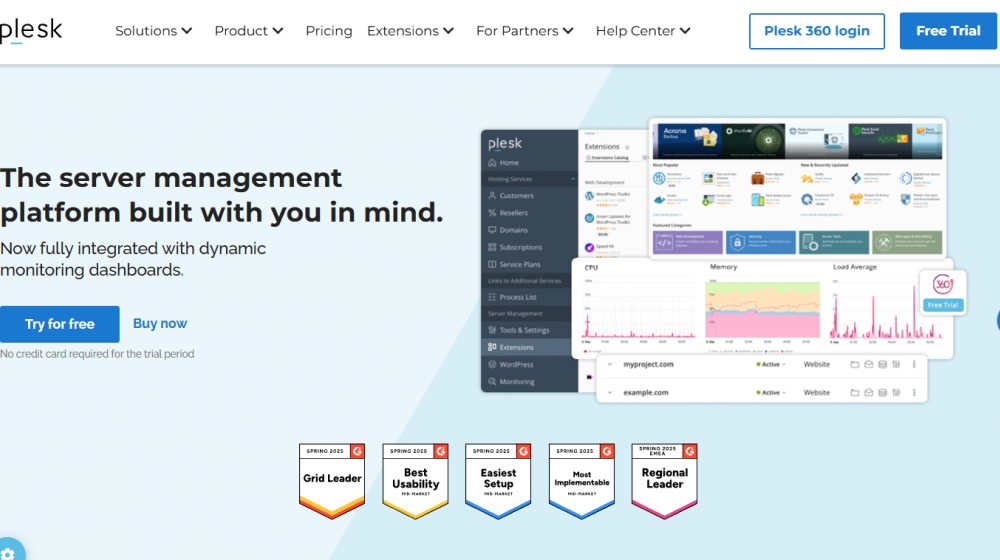
- Unified Control Panel: Centralized management for web servers, email, DNS, security, and backups. Intuitive UI for all user roles.
- WordPress Toolkit: Advanced staging, cloning, security scanning, smart updates, and bulk management for WordPress sites.
- Multi-Site & User Management: Allows granular control for agencies, resellers, and SMBs managing 1 to unlimited sites & users.
- Security Automation: 1-click SSL, malware scanning, curated server hardening, and scheduled updates across editions.
- App/Extension Marketplace: Growing library of add-ons (SEO, billing, Mail, analytics, site builders, AI content assistants, etc).
- Backup/Restore: Scheduled full and incremental backups, cloud backup integrations, self-service restoration options.
Workflow & User Experience
- New user onboarding in minutes; get started with templates and wizard-driven setup.
- Multi-role access: Admin, developer, designer, client, reseller.
- Modern UI with responsive design, supports mobile device server management and quick task automation.
- Tight integration with site builders, domain registration, and email configuration for end-to-end workflow inside Plesk.
- Bulk actions, real-time monitoring, and workflow automation minimize manual server admin.
- Self-service portal for recurring tasks (e.g., password resets, DNS changes, website restores).
Plesk Pricing
| Edition | Domains | Key Features | Price (Annual) |
|---|---|---|---|
| Web Admin | 10 | Core server & website admin, Sitejet builder, WP Toolkit SE | €12.04/mo (annual), €14.13/mo (USD – annual) |
| Web Pro | 30 | All Admin features + subscription/account mgmt, full WP Toolkit | €18.29/mo (annual), €21.42/mo (USD – annual) |
| Web Host | Unlimited | Reseller mgmt, advanced security, all platform extensibility | €31.38/mo (annual), €37.13/mo (USD – annual) |
| Partners | Custom | Variable discounts, priority support, direct volume plans | From €250/mo (minimum spend) |
Plesk vs. Competitors
| Plesk | cPanel | DirectAdmin | Cloudways | |
|---|---|---|---|---|
| Main use | Web server, agency & MSP hosting automation | Linux web hosting | Entry-level panel with limited automation | Managed cloud app hosting |
| WordPress Toolkit | Full, multi-site, staging & smart updates | Basic (plugin management only) | Manual setup required | Limited, platform-managed only |
| Add-ons & Extensions | Extensive, growing first- & third-party store | Large but mostly cPanel/WHM tools | Small library | Cloud & task-specific only |
| Pricing Model | Monthly/Annual, SaaS, partner volume | Monthly/Annual, per-server | Low-cost, per-server | Per-app/cloud usage |
| Best for | Agencies, SMBs, MSPs, SaaS hosters | Legacy hosts, sysadmins | Budget hosting, solo projects | No server admin, cloud startups |
Pro Tip: For startups or agencies managing both WordPress and custom app clients, Plesk’s auto-updating WP Toolkit and extension store streamline daily workloads and greatly reduce manual server upkeep.

Integrations
- WordPress, Joomla, Drupal (auto installers, security tools)
- Let’s Encrypt, Cloudflare, Softaculous, BoldGrid, Docker (DevOps/automation)
- Billing/CRM (WHMCS, Odin, selected ERPs)
- Mail (Postfix, Dovecot, premium email extensions, connectors for 3rd-party email/collab suites)
- Backup/storage: AWS S3, Google Drive, Dropbox, Azure, providers via plugins
- API for custom workflow and partner channel automation
Pros & Cons
| Pros | Cons |
|---|---|
|
|
Final Thoughts
Plesk stands out in 2026 as an all-in-one, cloud-ready automation layer for modern agencies, hosting providers, and digital-first businesses. With a strong focus on user workflow, deep WordPress integration, and a fast-evolving app marketplace, Plesk empowers teams to streamline hosting, security, and scaling—without requiring a full DevOps team. For those wanting best-in-class automation and growth flexibility, it remains the panel to beat.


Plesk FAQ
Yes, Plesk meets GDPR requirements and supports HIPAA compliance for eligible plans, often with a BAA on request.
Absolutely. White-label branding and custom domains are supported, especially on Pro and Host editions.
It’s ideal for digital agencies, MSPs, SaaS hosters, and technically-minded SMBs needing scalable multi-site, multi-user automation.
No, but Plesk integrates with leading billing and payment platforms as needed. Its focus is operations, not accounting.
All plans include 24/7 chat/email support. Partners and Host plans get dedicated onboarding and account management.


